3-(2,2,2-trifluoroacetamido)propanoyl chloride
- 发布日期: 2020-09-09
- 更新日期: 2026-10-23
产品详请
| 产地 |
武汉
|
| 货号 |
BK03360
|
| 品牌 |
Boren
|
| 用途 |
新药研发
|
| 型号 |
BK03360
|
| 包装规格 |
g/kg
|
| 外观 |
淡黄色液体
|
| CAS编号 |
87639-76-7
|
| 纯度 |
95%
|
| 别名 |
|
| 级别 |
医药级
|
| 重金属 |
ppm
|
**3-(2,2,2-Trifluoroacetamido)propanoyl Chloride Product Description**
**1. Product Structure**
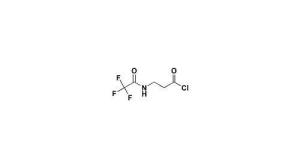
The compound has a molecular formula of C₅H₅ClF₃NO₂. Its structure is based on a β-alanyl skeleton (CH₂CH₂CO-), where the amino group (NH₂) forms an amide bond with the trifluoroacetyl group (CF₃CO-). The carboxyl group (-COOH) is converted to an acyl chloride (-COCl) via chlorination. The strong electron-withdrawing effect of the trifluoromethyl group (-CF₃) significantly enhances the reactivity of the acyl chloride moiety, making it an efficient acylating agent.
**2. Manufacturing Process**
Typically synthesized starting from β-alanine, which undergoes amidation with trifluoroacetic anhydride (TFAA) or trifluoroacetyl chloride (CF₃COCl) to form N-trifluoroacetyl-β-alanine. Subsequently, the carboxyl group is converted to an acyl chloride using chlorinating agents such as SOCl₂ or PCl₅. The reaction must be carried out under anhydrous conditions at a temperature controlled between 0-5°C to avoid side reactions. After distillation purification, high-purity product is obtained with a boiling point of 101-102°C (6 Torr).
**3. Application Scenarios**
As a specialty acylating agent, it is widely used in pharmaceutical synthesis (e.g., as an intermediate for anticancer drugs), pesticide development (e.g., fluorinated herbicides), and materials science (e.g., modification of fluoropolymers). Its high reactivity enables selective acylation reactions with alcohols, amines, etc., even at low temperatures, significantly improving synthetic efficiency. Additionally, the fluorine-containing structure imparts unique physicochemical properties (such as lipophilicity and metabolic stability) to the products, making it valuable in drug design.